Trains · Shanghai 上海磁浮
Riding the Shanghai Maglev at 431 km/h
Thirty kilometers in under eight minutes, floating on magnets: a traveler films the Shanghai Maglev at its old top speed of 431 km/h, from city to airport.
In short
- Creator Wayne Yeung filmed a full Shanghai Maglev run from Longyang Road to Pudong International Airport in 2015, when trains still reached 431 km/h.
- The line opened in 2004 and is described by the Pudong government as the first commercial high-speed maglev railway in the world.
- Today trains normally run at about 300 km/h, and the 30-kilometer trip takes around 8 minutes.
- A standard one-way ticket costs 50 yuan, or 40 yuan with a same-day flight ticket, according to a September 2025 Trip.com guide.
What happens in the video
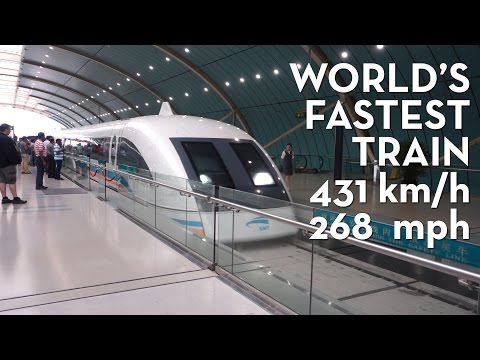
Wayne Yeung's video, posted in December 2015, is an invitation to take a seat. The creator rides the Shanghai Maglev from Longyang Road station in the city to Pudong International Airport, and in his description he says the 30-kilometer journey took just under seven and a half minutes, with the train reaching its top speed of 431 km/h. The video's thumbnail shows the sleek white train waiting at a platform under a curved roof.
The creator also points viewers to the 4:50 mark, where, he writes, two maglev trains pass each other at about 350 km/h. With both trains moving that fast in opposite directions, the encounter lasts only a moment. The whole video is just under eight minutes long, roughly the length of the trip itself.
How the Shanghai Maglev works, and how fast it runs today
A maglev has no wheels running on rails. As the Pudong government's visitor page explains, maglev trains levitate above the track and are pushed forward by electromagnetic force, which is what allows such high speeds with a very smooth ride. The Shanghai line started operating on January 29, 2004, and the district describes it as the first commercial high-speed maglev railway in the world. It links Longyang Road, in the Pudong district, with Pudong International Airport.
The 431 km/h in the video title was never an all-day speed. In 2017 the Pudong government's timetable listed 430 km/h only in two daytime windows, 9 to 10:45 a.m. and 1 to 4:45 p.m., with 300 km/h the rest of the day. Riders today should not expect the record figure at all: a September 2025 Trip.com guide gives the design speed as 430 km/h but the normal operating speed as around 300 km/h, with the trip taking about 8 minutes. That puts it in the same range as the cruising speed of China's fastest bullet trains.
For a sense of how smooth China's conventional high-speed trains have become, compare this with the coin balancing on a Fuxing bullet train at 350 km/h.
How to ride the Shanghai Maglev
The maglev is most useful as an airport transfer for travelers flying into or out of Shanghai Pudong. Longyang Road is not in the city center, so plan on changing to the metro there: the station connects with Metro Lines 2, 7, 16 and 18, and the airport station connects with Line 2.
| Ticket | Price |
|---|---|
| Standard one-way | 50 yuan |
| Standard one-way with a same-day flight ticket | 40 yuan |
| Standard round trip, valid 7 days | 80 yuan |
| VIP one-way | 100 yuan |
| VIP round trip | 160 yuan |
- Paying: Trip.com reports that ticket counters take cash, Alipay and WeChat Pay, and that UnionPay, Visa and Mastercard bank cards work at the gates at the standard fare. China's official 2026 guide for foreign visitors confirms that tap-to-ride with overseas bank cards covers both the maglev and Shanghai's urban metro lines.
- Flight discount: To get the 40-yuan fare, buy at the counter or ticket machine and have your same-day flight ticket ready; card taps at the gate are charged the standard fare.
- Hours: Trip.com lists the first train at 6:45 a.m. from Longyang Road and 7:02 a.m. from the airport, and the last trains at about 9:40 p.m. Landing late? You will need the metro or a taxi instead.
Our metro guide covers tapping in with a foreign card and using transit QR codes, and the Alipay and WeChat Pay guide explains how to set up mobile payment before you land.
Mandarin for the maglev and the airport
The free tickets and station entry lesson covers buying a ticket and paying by phone, the last train lesson helps if you land late, and the leaving the airport lesson and platforms and transfers lesson get you from the arrivals hall to the right train.
Buying a ticket and making the connection
-
可以买单程票吗?
Kěyǐ mǎi dānchéng piào ma?
Can I buy a one-way ticket?
-
可以手机支付吗?
Kěyǐ shǒujī zhīfù ma?
Can I pay by mobile phone?
-
这趟车到机场吗?
Zhè tàng chē dào jīchǎng ma?
Does this train go to the airport?
-
末班车是几点?
Mòbān chē shì jǐ diǎn?
What time is the last service?
-
在哪里换乘?
Zài nǎlǐ huànchéng?
Where do I transfer?
-
请问地铁站在哪里?
Qǐngwèn dìtiě zhàn zài nǎlǐ?
Excuse me, where is the metro station?
About this video
“Shanghai Maglev @ 431km/h (268mph) // World's fastest train!” was made and published by Wayne Yeung on YouTube. It is embedded here with YouTube’s player, and all rights stay with its creator. Chinese for Travel is not affiliated with Wayne Yeung. The text on this page is our own.
Are you the creator? Email smile@thinksview.com and we will change or remove this page.
Learn the Mandarin for the trip
- 27 Metro tickets and entering the stationMetro & bus · 23 phrases with audio
- 30 Hours, last trains and delays in ChineseMetro & bus · 23 phrases with audio
- 11 Leaving the airport in ChineseAirport · 24 phrases with audio
- 28 Metro lines, platforms and transfersMetro & bus · 23 phrases with audio
- How to ride the metro in China's big citiesTravel guide
- How to use Alipay and WeChat Pay in China as a foreignerTravel guide


