Health
Pharmacies, medicine and hospitals in China: what visitors need to know
Find a pharmacy (药店) in China, know what needs a prescription, bring your own medicine legally, and see a doctor: registration, paying and insurance.
In short
- For minor problems, pharmacies (药店, yàodiàn) are easy to find in cities and sell many medicines over the counter; antibiotics and other prescription drugs need a doctor’s prescription.
- You can bring ordinary medicines for personal use in reasonable quantities; for narcotic or psychotropic medicines, carry a doctor’s certificate and declare them at customs.
- At public hospitals you register, see the doctor, then pay before each test or prescription, usually with Alipay, WeChat Pay or cash.
- International departments and private clinics in big cities have English-speaking staff and can bill some insurers directly, at a higher price.
- In a medical emergency in mainland China, call 120 for an ambulance.
Where can you buy medicine in China?
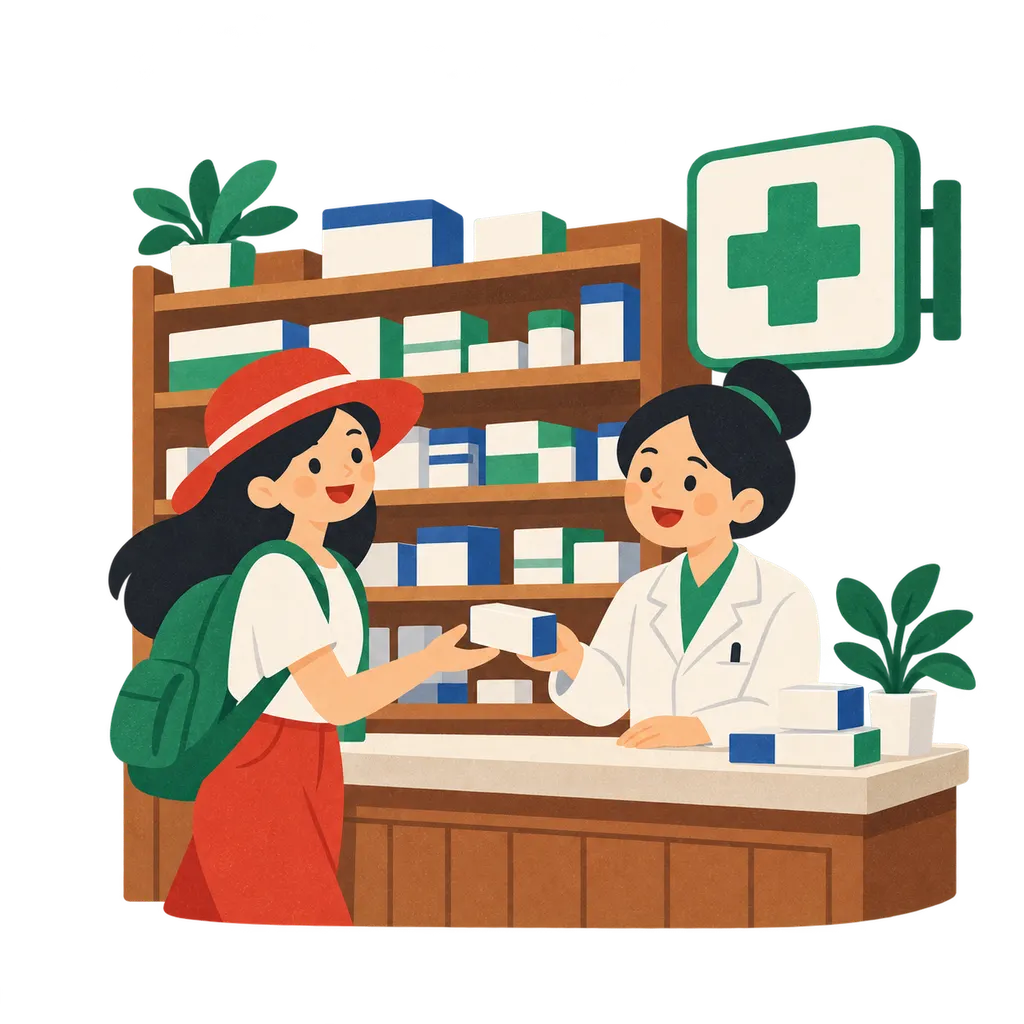
Go to a pharmacy: look for the characters 药店 (yàodiàn), 药房 (yàofáng) or 大药房 (dà yàofáng), usually with a green cross. Chain pharmacies are on most city streets and in many malls and stations, and some are open 24 hours (24小时). Your hotel front desk can point you to the nearest one. Staff rarely speak much English, so show the box of what you use at home or a photo of it, and know the generic name (active ingredient) rather than the brand, since brand names differ between countries.
Chinese pharmacies sell both Western medicine (西药, xīyào) and traditional Chinese medicine (中药, zhōngyào), often side by side. If you want a Western medicine, say so, and tell the pharmacist about anything else you take. The pharmacy lesson has these phrases with audio, and the Chinese for Travel app keeps them ready to show staff.
At the pharmacy
-
附近有药店吗?
Fùjìn yǒu yàodiàn ma?
Is there a pharmacy nearby?
-
我想买药。
Wǒ xiǎng mǎi yào.
I would like to buy medicine.
-
有退烧药吗?
Yǒu tuìshāo yào ma?
Do you have fever medicine?
-
有感冒药吗?
Yǒu gǎnmào yào ma?
Do you have cold medicine?
-
有止痛药吗?
Yǒu zhǐtòng yào ma?
Do you have painkillers?
-
有过敏药吗?
Yǒu guòmǐn yào ma?
Do you have allergy medicine?
-
这个需要处方吗?
Zhège xūyào chǔfāng ma?
Does this require a prescription?
-
请帮我写下用法用量。
Qǐng bāng wǒ xiě xià yòngfǎ yòngliàng.
Please write down the instructions and dosage for me.
Describing symptoms
-
我发烧了。
Wǒ fāshāo le.
I have a fever.
-
我头疼。
Wǒ tóuténg.
I have a headache.
-
我肚子痛。
Wǒ dùzi tòng.
I have a stomachache.
-
我头晕。
Wǒ tóuyūn.
I feel dizzy.
-
我想吐。
Wǒ xiǎng tù.
I feel like vomiting.
-
我咳嗽。
Wǒ késou.
I have a cough.
-
我喉咙痛。
Wǒ hóulóng tòng.
I have a sore throat.
-
我拉肚子。
Wǒ lā dùzi.
I have diarrhea.
What medicine can you buy without a prescription in China?
China separates over-the-counter (OTC) from prescription medicines. OTC boxes carry an oval “OTC” logo: red for Class A, sold only in pharmacies with a licensed pharmacist, and green for Class B, which approved general stores may also sell (China Daily, NMPA rules). Prescription medicines (处方药, chǔfāngyào), including antibiotics, legally need a prescription from a licensed doctor, so a pharmacy should not sell them to you without one.
| Type | How to recognize it | Where to get it |
|---|---|---|
| OTC, Class A | Red OTC logo on the box | Pharmacies with a licensed pharmacist |
| OTC, Class B | Green OTC logo | Pharmacies and some approved general stores |
| Prescription medicine | No OTC logo; the box usually says it’s sold on a doctor’s prescription | A pharmacy, with a prescription, or the hospital pharmacy after your appointment |
| Traditional Chinese medicine | Labeled 中药 or 中成药; can be OTC or prescription | Pharmacies; ask the pharmacist before mixing it with other medicines |
Some cold remedies containing ephedrine-type ingredients are kept behind the counter, and pharmacies record the buyer’s ID and limit how many packs you can buy at once (2012 regulator notice), so carry your passport. For anything beyond a minor complaint, or if you don’t improve, ask a pharmacist or see a doctor.
⚠︎ Don’t count on refills in China
A prescription from home isn’t something a Chinese pharmacy can fill, and the UK government notes that local doctors may want to examine you before prescribing again, while some foreign brands aren’t available at all (FCDO). Bring enough medicine for the whole trip plus extra for delays, as the CDC advises.
Can you bring your own medicine into China?
Yes, within limits. As of October 2026, Shanghai Customs’ guidance is that medicines without narcotic or psychotropic ingredients may be carried in reasonable quantities for personal use, subject to customs checks. There is no fixed number of days or boxes; officers judge what is reasonable for your trip (Shanghai government).
Narcotic and psychotropic medicines are controlled. The same guidance allows Category I medicines up to the maximum quantity on a single prescription, carried with a medical diagnosis certificate from a medical institution and your passport, and asks travelers to declare them to customs; for Category II, bring prescriptions or medical records (Shanghai government, Chongqing government). Some ADHD, strong pain, sleep and anxiety medicines can fall into these groups. China’s classification may differ from your country’s, so if you’re unsure, ask the Chinese embassy or consulate before you travel. The customs lesson covers what officers ask and how to answer.
- Check before you bookAsk your doctor whether any of your medicines are controlled, and confirm with the Chinese embassy or consulate if they might be.
- Get a doctor’s letterIt should list your condition and each medicine by generic name and dose. For controlled medicines, bring a diagnosis certificate from your clinic or hospital.
- Pack it in your carry-onKeep medicines in their original labeled packaging with a copy of the prescription, plus a few days’ spare.
- Declare when in doubtUse the red “goods to declare” channel for controlled medicines or if you’re not sure, and show your documents.
- Keep the papers with youYou may need them again at the pharmacy, at a hospital or when you leave.
At customs
-
我带了一些自用药品。
Wǒ dài le yìxiē zìyòng yàopǐn.
I brought some medicine for personal use.
-
这是我的处方。
Zhè shì wǒ de chǔfāng.
This is my prescription.
-
这些是我自己用的。
Zhèxiē shì wǒ zìjǐ yòng de.
These are for my personal use.
-
这些东西需要申报吗?
Zhèxiē dōngxi xūyào shēnbào ma?
Do these items need to be declared?
-
这个可以带入境吗?
Zhège kěyǐ dài rùjìng ma?
Can I bring this into the country?
Should you go to a hospital or an international clinic?
Family doctor (GP) clinics are uncommon in China, so people go to hospital outpatient departments even for routine problems. Big public hospitals are well equipped but crowded, and most staff speak only Chinese. Many large hospitals in major cities run an international department (国际医疗部, guójì yīliáo bù) with English-speaking staff, and private international hospitals and clinics operate in the biggest cities, at much higher prices.
| Option | Good for | Language and cost |
|---|---|---|
| Public hospital outpatients (门诊, ménzhěn) | Most illnesses, tests, prescriptions | Mostly Chinese; lowest fees, paid step by step |
| Public hospital emergency (急诊, jízhěn) | Urgent problems, day and night | Mostly Chinese; pay as you go, deposit if admitted |
| International department of a public hospital | Non-urgent care in English | English usually available; higher fees, some direct billing |
| Private international hospital or clinic | Routine and urgent care in big cities | English; highest fees, direct billing with many insurers |
To find one, Beijing’s government publishes a medical guide for foreigners listing hospitals with international departments, and the UK government keeps a list of hospitals in China with some English-speaking staff. Your travel insurer’s assistance line can also recommend a hospital.
How does hospital registration (挂号) work in China?
Chinese hospitals work in a fixed order: register (挂号, guàhào), see the doctor, pay for whatever the doctor orders, then do the tests or collect the medicine (National Health Commission).
- Book or registerBook through the hospital’s WeChat or Alipay mini program or app, where many hospitals let you register with a passport number, or go to the registration window (挂号处, guàhàochù) with your passport. In Beijing, the city’s 114 booking platform has an English mode for foreign patients.
- Pick the departmentIf you don’t know which department you need, ask at the information or triage desk (导诊台, dǎozhěntái). Internal medicine is 内科 (nèikē) and surgery is 外科 (wàikē).
- Keep your patient cardFirst-time patients get a hospital card, or an electronic one in the app. It is used for every payment, test and later visit.
- Wait for your numberScreens outside the consulting rooms show the queue. Have a written list of your symptoms, medicines and allergies ready; consultations are often short.
- Pay, then testPay for tests or medicine (缴费, jiǎofèi) at a window, a kiosk or in the app, then go for tests. If results take until another day, you may need to register again to see the doctor.
- Collect medicine and papersPick up medicine at the hospital pharmacy (药房, yàofáng), and ask for receipts (发票, fāpiào) and your medical record (病历, bìnglì) for your insurer.
At the hospital
-
我不舒服。
Wǒ bù shūfu.
I do not feel well.
-
我需要医生。
Wǒ xūyào yīshēng.
I need a doctor.
-
附近有医院吗?
Fùjìn yǒu yīyuàn ma?
Is there a hospital nearby?
-
请带我去医院。
Qǐng dài wǒ qù yīyuàn.
Please take me to the hospital.
-
我有旅行保险。
Wǒ yǒu lǚxíng bǎoxiǎn.
I have travel insurance.
-
可以帮我翻译给医生吗?
Kěyǐ bāng wǒ fānyì gěi yīshēng ma?
Could you help translate for the doctor?
-
请帮我写下诊断结果。
Qǐng bāng wǒ xiě xià zhěnduàn jiéguǒ.
Please help me write down the diagnosis.
Practice them in the illness and doctor lesson.
How do you pay for medical care in China, and will insurance cover it?
Healthcare in China isn’t free for visitors, and you pay as you go. Most hospitals take Alipay, WeChat Pay and cash; many don’t accept foreign cards, though international departments often do (FCDO). Set up mobile payment before the trip using the Alipay and WeChat Pay guide. If you are admitted, expect to pay a deposit first; the UK government cites deposits of 3,000–7,000 yuan, with unused money refunded when you leave.
Get travel insurance that covers medical treatment and evacuation, which the UK government and the CDC both recommend. Many public hospitals won’t bill a foreign travel insurer directly, so you pay and claim afterward with your receipts and records. International departments and private hospitals bill some insurers directly; Beijing’s guide notes that patients with high-end commercial insurance can show their insurance card and passport so the hospital settles with the insurer. Call your insurer’s assistance line before non-urgent treatment.
What should you do in a medical emergency in China?
Call 120 for an ambulance (FCDO); in Beijing, 999 also reaches an emergency medical service. Ambulances charge a fee. Say 请叫救护车 (“Please call an ambulance”) to anyone nearby, and ask hotel staff to call and give your location in Chinese; an address card helps, and the emergency help lesson has the key calls for help. Large hospitals have emergency departments (急诊) open around the clock. Once you’re safe, contact your insurer, and your embassy or consulate if it’s serious. The emergency numbers guide has more.
Frequently asked questions
Do pharmacists in China speak English?
Rarely, outside international areas of big cities. Show the medicine box or its generic name, use a few phrases, or type your symptoms into a translation app.
Can I buy antibiotics without a prescription in China?
Legally, no: antibiotics are prescription-only. See a doctor, who can prescribe them if you need them.
Are hospitals in China open at weekends?
Emergency departments are open 24 hours a day. Outpatient hours vary by hospital, so check its mini program or call ahead.
Is tap water safe to drink in China?
The CDC advises against it, even in big cities. Drink bottled or boiled water, which hotels and restaurants provide.
Practice the Mandarin for this
- 56 Pharmacy and buying medicine in ChineseHelp · 23 phrases with audio
- 55 Illness, injury and seeing a doctorHelp · 23 phrases with audio
- 9 Customs declaration in ChineseAirport · 20 phrases with audio
- 53 Asking for help and calling the policeHelp · 23 phrases with audio
- 57 Accidents, embassy and emergency contactsHelp · 23 phrases with audio
Sources
Facts checked October 31, 2026. Rules change; check the official source before you travel.
- Shanghai government (Shanghai Customs): Can I bring medication for personal use when traveling through Shanghai? (updated October 2026)
- Chongqing government: Entry and exit FAQs on carrying medicine (June 2026)
- National Health Commission: Common procedures of seeing the doctor at Chinese hospitals
- Shanghai government: How to see a doctor at a local hospital
- Beijing government: Medical Guide for Foreigners in Beijing
- China Daily (government topics): Prescription and OTC drugs
- UK FCDO: Medical treatment in China (April 2025)
- UK FCDO: China travel advice, health
- UK FCDO: List of hospitals in China
- US CDC: Travelers’ health, China
- BaiPharm: Notice on further strengthening the administration of ephedrine-containing compound preparations (2012)