Food & drink
How to order food in a Chinese restaurant
Order food in China with confidence: scan-to-order QR codes, picture menus, portion sizes, spice levels, rice and tea, calling staff, paying and leftovers.
In short
- Many city restaurants let you order by scanning a QR code on the table with WeChat or Alipay, but staff will still take your order if you point at a menu.
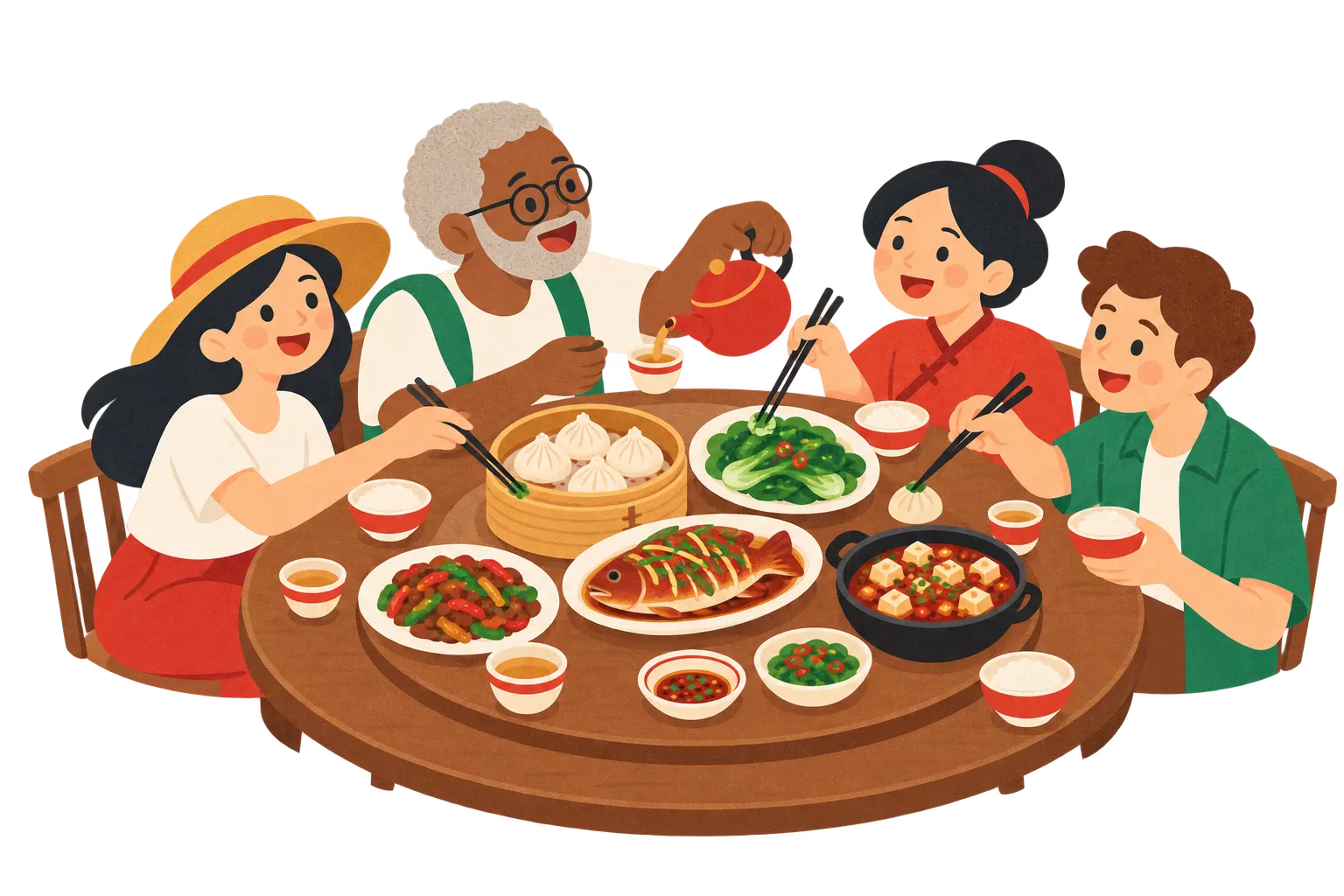
- Dishes are shared by the whole table: order roughly one dish per person plus rice, and ask how many people a dish feeds.
- Say 微辣 (wēilà, mild) or 不辣 (bú là, not spicy) when you order; “mild” in a Sichuan or Hunan kitchen can still be hot.
- Tipping is not expected; check the bill for a service charge or a per-person tea charge instead.
- Taking leftovers home (打包, dǎbāo) is normal, and you usually pay at the counter or by scanning a code at the table.
How do you order food in a Chinese restaurant?
At a sit-down restaurant, staff ask how many people you are (几位, jǐ wèi), seat you, and then you order for the whole table at once, either by scanning the QR code on the table or from a paper menu. Dishes arrive as soon as the kitchen finishes them, not in courses, and everyone shares. You call staff over when you need something and pay at the end. At noodle shops and fast-casual places it is the other way round: you order and pay first at the counter, a kiosk or a QR code, then wait for your food.
| Type of place | How you order | When you pay |
|---|---|---|
| Sit-down restaurant (餐厅, cāntīng) | QR code on the table, paper menu or tablet | At the end, at the counter or by scanning a code |
| Noodle, dumpling or fast-casual shop | At the counter, a kiosk or a wall QR code | Before you eat |
| Hot pot (火锅, huǒguō) | Pick a broth and spice level, then tick raw ingredients | At the end; the self-serve sauce station is sometimes charged per person |
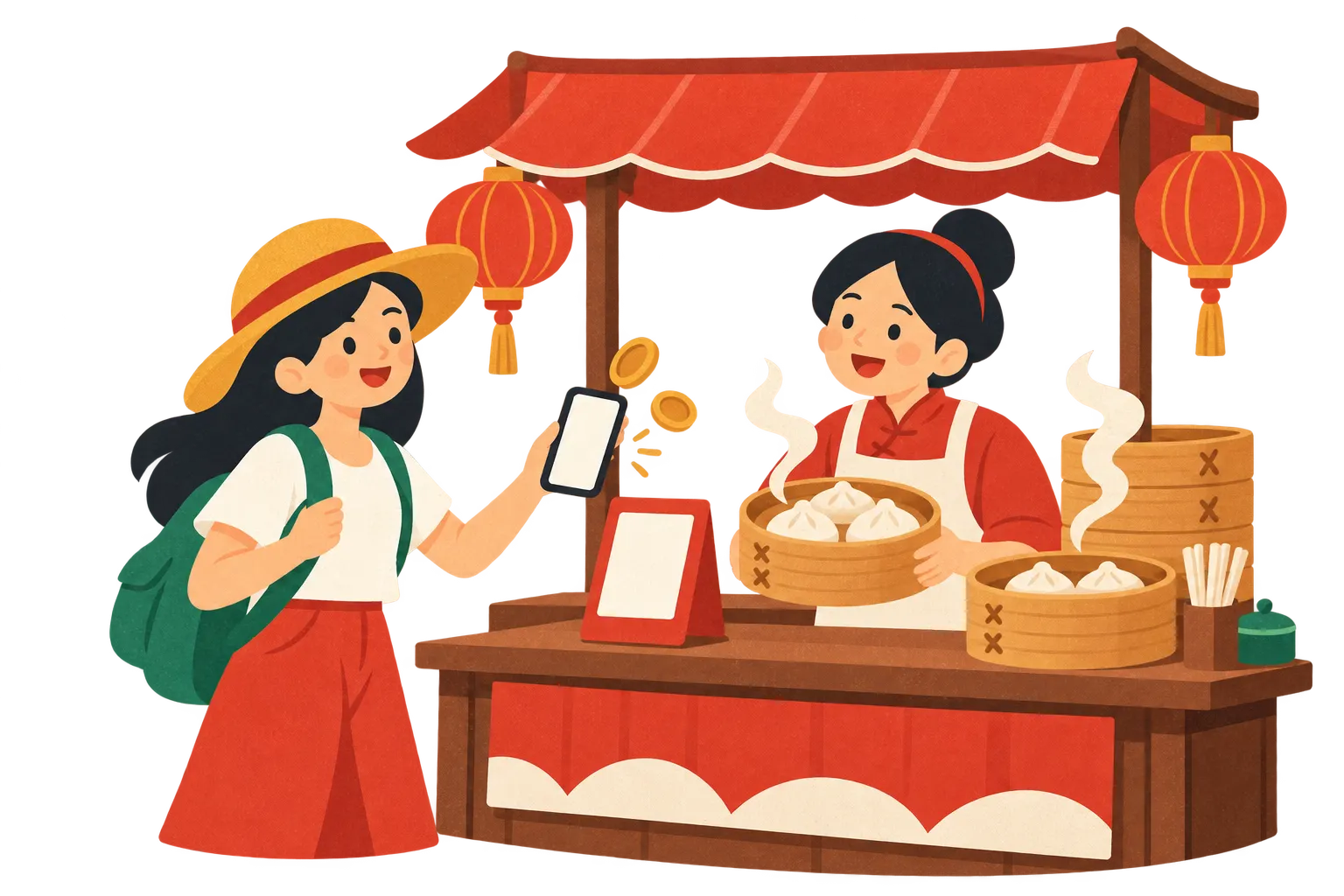
| Street food and night markets | Point at what you want | On the spot, usually by scanning the stall’s QR code |
Popular restaurants often give out queue numbers instead of taking reservations: you take a ticket or scan a code at the door and wait to be called. The table and queue lesson covers what staff say at the door.
How does QR code ordering work?
Scan-to-order (扫码点餐, sǎomǎ diǎncān) is common in cities. A sticker on the table opens the restaurant’s menu as a mini program inside WeChat or Alipay, already linked to your table number. Some menus have an English switch; many don’t.
- Scan inside the appOpen the scanner in WeChat or Alipay rather than your phone camera; the camera app often can’t open the menu.
- Allow or skip the loginSome menus ask to use your phone number or account. If the menu demands a Chinese phone number or won’t load, stop here and ask staff to order for you.
- Choose dishes and optionsTap the dishes you want. Look for option pop-ups for portion size and spice level before you add them to the cart.
- Enter the number of dinersMany menus ask how many people are eating; tableware, rice or tea may be charged per person.
- Submit, then pay now or laterSome restaurants take payment when you submit; others send the order to the kitchen and you pay before you leave.
To read a Chinese-only menu, a camera translation app helps. In October 2025 Shanghai’s city government pointed visitors to the menu translation tool in Alipay’s Easy Go service. If none of this works, a server will take your order the old way.
Getting a menu and ordering
What if there’s no English menu?
Many menus in China have photos, so pointing works well: point at the picture and say 我要这个 (wǒ yào zhège, “I’d like this”). If you like the look of a dish at the next table, it’s fine to point it out to the server. Learning a handful of cooking and ingredient words lets you read the dish names themselves; our Chinese menu words page lists the common ones, and the ordering lesson has them with audio.
| Chinese | Pinyin | Meaning |
|---|---|---|
| 炒 | chǎo | stir-fried |
| 蒸 | zhēng | steamed |
| 烤 | kǎo | roasted or grilled |
| 炸 | zhà | deep-fried |
| 红烧 | hóngshāo | braised in soy sauce |
| 鸡 / 牛 / 猪 | jī / niú / zhū | chicken / beef / pork |
| 鱼 / 虾 | yú / xiā | fish / shrimp |
| 豆腐 | dòufu | tofu |
| 面 / 饭 | miàn / fàn | noodles / rice |
How much food should you order in China?
Dishes are served on shared plates in the middle of the table, and everyone takes from them with their own chopsticks or a serving pair. A useful starting point is one dish per person plus rice or another staple, then add more if you’re still hungry. Portions vary a lot, so ask 这个菜大概几个人吃 (“About how many people is this dish for?”). Many menus also offer a small portion (小份, xiǎofèn).
Don’t worry if staff suggest you’ve ordered enough. Under China’s 2021 anti-food-waste law, restaurants must remind diners to avoid waste, and they may charge a fee for excessive leftovers as long as the rate is clearly displayed (Xinhua report on the law).
Rice (米饭, mǐfàn) usually has to be ordered separately and is often charged per bowl. Staples such as rice, noodles and dumplings sometimes arrive last, so ask for the rice to come with the dishes if you want it early.
How do you ask for mild or no spice in Chinese?
Many menus mark spicy dishes with chili icons, and QR menus often make you choose a spice level. The words below are the ones you will see and hear. Sichuan food also uses 麻 (má), the tingling, numbing feeling from Sichuan pepper, which is separate from chili heat; 麻辣 (málà) means both.
| Chinese | Pinyin | What it means |
|---|---|---|
| 不辣 | bú là | not spicy |
| 微辣 | wēilà | mild, a little spicy |
| 中辣 | zhōnglà | medium |
| 特辣 | tèlà | extra hot |
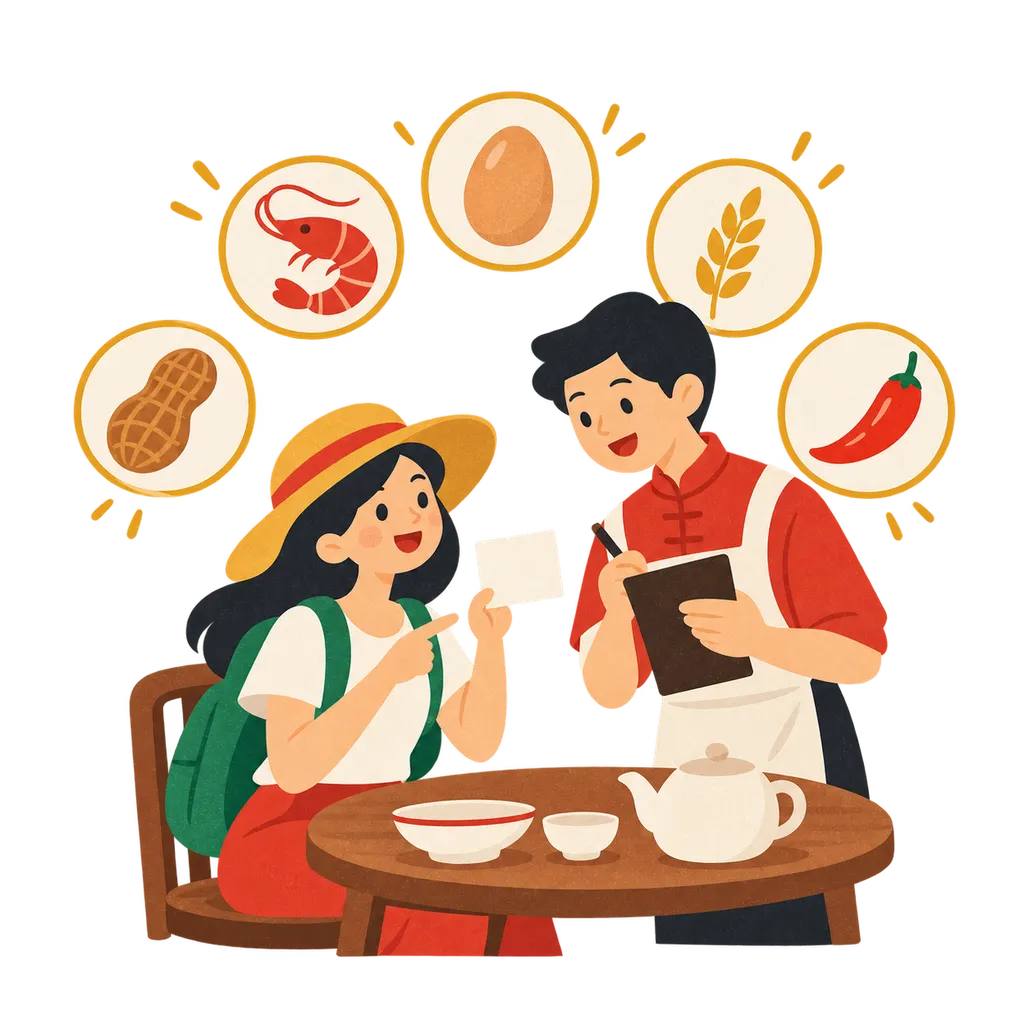
Spice scales are relative to the local cuisine: mild in a Sichuan or Hunan restaurant can be hotter than medium elsewhere. If you don’t eat chili at all, say so clearly when you order rather than relying on the option button. For allergies and diets, see the food allergy and vegetarian guide.
Choosing the spice level
-
这个菜辣吗?
Zhège cài là ma?
Is this dish spicy?
-
我不能吃辣。
Wǒ bù néng chī là.
I cannot eat spicy food.
-
请做不辣的。
Qǐng zuò bú là de.
Please make it not spicy.
-
请少放辣椒。
Qǐng shǎo fàng làjiāo.
Please use less chili.
-
我要微辣。
Wǒ yào wēilà.
I would like it mildly spicy.
-
我要中辣。
Wǒ yào zhōnglà.
I would like it medium spicy.
-
不要太辣。
Búyào tài là.
Not too spicy, please.
Do restaurants in China serve free tea and water?
Many restaurants pour tea or hot water when you sit down, often at no charge. Tap water in China isn’t safe to drink (CDC), so drinking water in restaurants is boiled and usually served hot or warm; ask for bottled water or ice water if you prefer it cold.
Some places add small extras to the bill. Cantonese dim sum restaurants commonly charge a per-person tea charge (茶位费, cháwèifèi), and in December 2025 Guangdong’s market regulator published draft rules requiring restaurants to disclose such charges before you order (Eye Shenzhen). Some restaurants also put shrink-wrapped tableware sets on the table and charge a small amount for them. If you’re unsure what a line on the bill is, ask.
How do you call the waiter in China?
Staff in busy Chinese restaurants won’t usually come by to check on you, so you call them. Raise your hand and say 服务员 (fúwùyuán) clearly; calling out across the room is normal and not rude. Some tables have a call button. The same goes for adding dishes, asking for more napkins, or chasing a dish that hasn’t come. If something is wrong with a dish, the food problems lesson has what to say.
Asking staff for things
-
服务员,您好。
Fúwùyuán, nín hǎo.
Excuse me, waiter / waitress.
-
我们想加菜。
Wǒmen xiǎng jiā cài.
We would like to order more dishes.
-
请给我们一杯水。
Qǐng gěi wǒmen yì bēi shuǐ.
Please give us a glass of water.
-
请给我们一壶热水。
Qǐng gěi wǒmen yì hú rèshuǐ.
Please give us a pot of hot water.
-
请给我们一些纸巾。
Qǐng gěi wǒmen yìxiē zhǐjīn.
Please give us some napkins.
-
请给我们公筷。
Qǐng gěi wǒmen gōngkuài.
Please give us serving chopsticks.
-
这个菜还要多久?
Zhège cài hái yào duōjiǔ?
How much longer will this dish take?
How do you pay at a restaurant in China?
Ask for the bill with 买单 (mǎidān) or 结账 (jiézhàng). Depending on the restaurant, you scan the QR code on your table, scan the restaurant’s code at the counter (收银台, shōuyíntái), or show your own payment code. Alipay and WeChat Pay linked to a foreign card work in most restaurants; see the Alipay and WeChat Pay guide to set them up before you go. Larger restaurants may take foreign cards, and a March 2024 State Council guideline calls on dining businesses to accept cash and keep change (Shanghai government summary), so carry some yuan as a backup.
There is no tipping. Shanghai’s tourism authority notes that restaurants and bars in hotels, and some outside them, may add a 10–15% service charge, and that tips aren’t expected in most restaurants (Shanghai FAQ). More on this in the etiquette and tipping guide.
Packing leftovers (打包, dǎbāo) is completely normal, including at nice restaurants. Staff bring a box, sometimes for a small fee. If you need an official receipt for work, ask for a 发票 (fāpiào) before you pay. The bill and leftovers lesson covers splitting the bill too.
⚠︎ Check before you pay
Make sure the total matches what you ordered and that you’re scanning the restaurant’s own code. Be wary of friendly strangers who invite you to a teahouse or bar in tourist areas: the UK government warns that these “tea tasting” invitations can end with a huge bill (FCDO).
Paying and taking food home
-
服务员,您好,我们想结账。
Fúwùyuán, nín hǎo, wǒmen xiǎng jiézhàng.
Excuse me, we would like to pay the bill.
-
这里面包含服务费吗?
Zhèlǐmiàn bāohán fúwùfèi ma?
Does this include the service charge?
-
可以用现金付款吗?
Kěyǐ yòng xiànjīn fùkuǎn ma?
Can I pay in cash?
-
可以用支付宝付款吗?
Kěyǐ yòng Zhīfùbǎo fùkuǎn ma?
Can I pay with Alipay?
-
我可以扫码付款吗?
Wǒ kěyǐ sǎomǎ fùkuǎn ma?
Can I scan the code to pay?
-
可以分开付款吗?
Kěyǐ fēnkāi fùkuǎn ma?
Can we pay separately?
-
剩下的可以打包吗?
Shèngxià de kěyǐ dǎbāo ma?
Can we pack the leftovers?
-
可以给我们一个打包盒吗?
Kěyǐ gěi wǒmen yí ge dǎbāo hé ma?
Could you give us a takeaway box?
Frequently asked questions
Do restaurants in China have English menus?
Chains and restaurants near big sights often do, and some QR menus have an English switch, but many local places don’t. Picture menus, pointing and a camera translation app cover most situations.
Can I order food in China without WeChat or a Chinese phone number?
Yes. If the QR menu needs an account or a Chinese number, ask staff to take your order from a paper menu or tablet, then pay with Alipay, cash or a card where accepted.
Is it rude to leave food on the plate in China?
Leaving a little isn’t rude, but ordering far more than you can eat is frowned on. Order in rounds and pack what’s left.
Can I eat alone at a Chinese restaurant?
Yes. Noodle shops, dumpling places and fast-casual restaurants are built for solo diners, and many sit-down restaurants offer small portions or set meals for one.
Practice the Mandarin for this
- 38 Ordering food and asking for recommendationsFood · 23 phrases with audio
- 39 Spice levels, allergies and diets in ChineseFood · 23 phrases with audio
- 41 The bill, leftovers and invoiceFood · 23 phrases with audio
- 40 Extra orders, service and tablewareFood · 23 phrases with audio
- 37 Getting a table in ChineseFood · 23 phrases with audio
- 42 Food problems and changing dishesFood · 23 phrases with audio
Sources
Facts checked October 31, 2026. Rules change; check the official source before you travel.
- Shanghai Municipal Administration of Culture and Tourism: Is tipping necessary when dining in Shanghai?
- Shanghai government: Key measures to enhance payment services (State Council guideline, March 2024)
- Shanghai government: CIIE service guide, dining solutions for international visitors (October 2025)
- Xinhua via NPC: Law against food waste comes into force (April 2021)
- Eye Shenzhen: Guangdong draft rules on disclosing tea charges (December 2025)
- UK FCDO: China travel advice, safety and security
- US CDC: Travelers’ health, China
- Shanghai government (China Daily): Guide to table etiquette in China