Food & drink
Eating in China with a food allergy or special diet
How to explain food allergies and vegetarian, vegan, halal or gluten-free needs in China, which hidden ingredients to ask about, and why a written card helps.
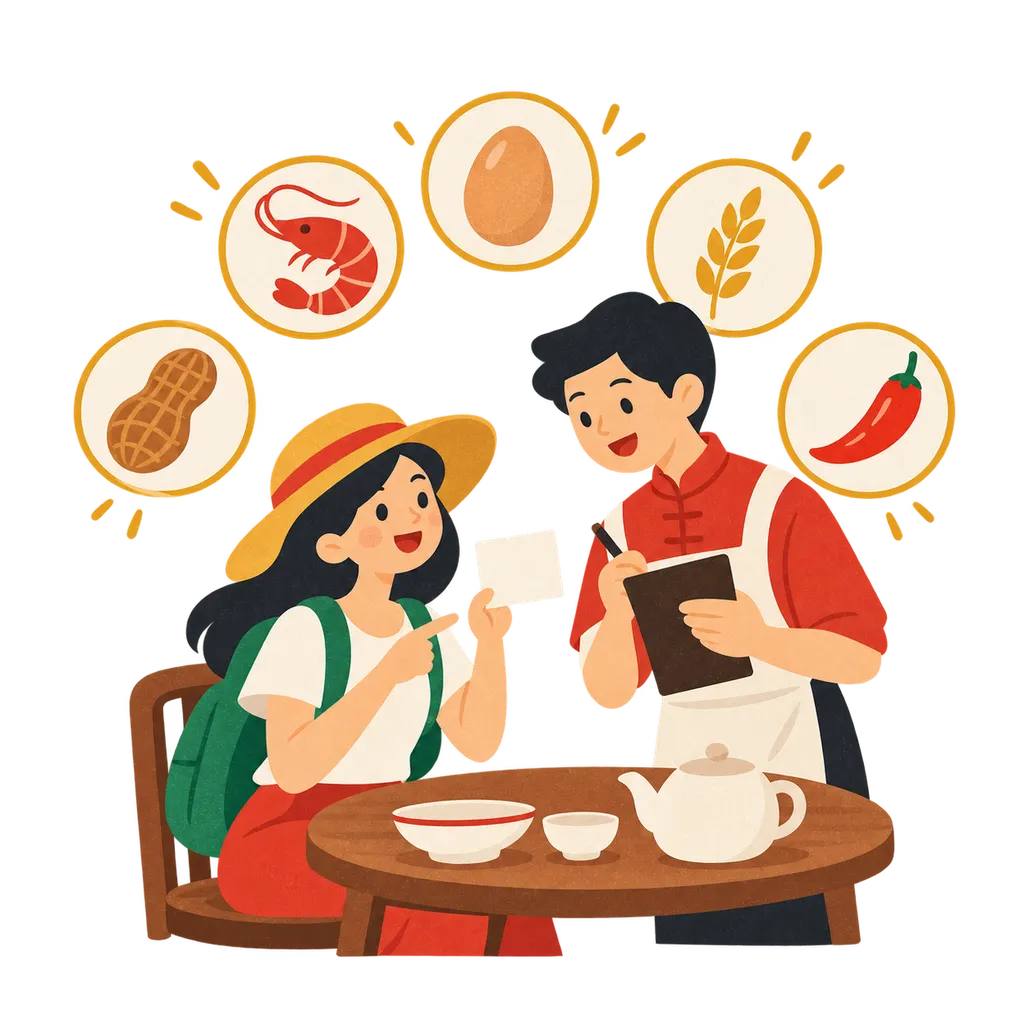
In short
- The key sentence is 我对___过敏 (Wǒ duì ___ guòmǐn, “I am allergic to ___”); say it before you order and show it in writing.
- Hidden ingredients are the main risk: peanut oil, lard, chicken stock, oyster sauce, dried shrimp and wheat-based soy sauce turn up in dishes that look safe.
- Vegetarian (素食, sùshí) is widely understood, but spell out that you also don’t eat meat broth, lard or fish.
- A written card helps the message reach the kitchen, but it can’t guarantee a dish is safe; with a severe allergy, carry your own prescribed medication.
- In a medical emergency in mainland China, call 120 for an ambulance.
How do I tell a restaurant about my food allergy in Chinese?
Use the pattern 我对___过敏 (Wǒ duì ___ guòmǐn), “I am allergic to ___”: 我对花生过敏 means “I am allergic to peanuts.” Say it when you sit down, before anyone orders, then ask about each dish and ask staff to confirm with the kitchen. Because the person taking your order is rarely the cook, show the same words in writing so they can be passed on exactly.
- Say it firstTell the server about your allergy as soon as you sit down, and show your written card.
- Ask about each dishPoint at a dish and ask whether it contains your allergen. Ask what is in sauces, too: a dish name rarely lists them.
- Ask them to check with the kitchenAsk staff to confirm the dish doesn’t contain those ingredients, and say that it is very important to you.
- Watch for hesitationIf the answer is vague, choose a simpler dish, such as plain steamed vegetables or rice, or eat somewhere else.
- Check what arrivesLook at the dish before you eat. Visible peanuts, sesame seeds or shrimp mean the message didn’t get through.
Explaining an allergy
-
我对花生过敏。
Wǒ duì huāshēng guòmǐn.
I am allergic to peanuts.
-
我对海鲜过敏。
Wǒ duì hǎixiān guòmǐn.
I am allergic to seafood.
-
我对坚果过敏。
Wǒ duì jiānguǒ guòmǐn.
I am allergic to nuts.
-
我对牛奶过敏。
Wǒ duì niúnǎi guòmǐn.
I am allergic to milk.
-
我对鸡蛋过敏。
Wǒ duì jīdàn guòmǐn.
I am allergic to eggs.
-
这个菜里面有花生吗?
Zhège cài lǐmiàn yǒu huāshēng ma?
Does this dish contain peanuts?
-
请确认这个菜没有这些食材。
Qǐng quèrèn zhège cài méiyǒu zhèxiē shícái.
Please confirm that this dish does not contain these ingredients.
-
这个对我很重要。
Zhège duì wǒ hěn zhòngyào.
This is very important to me.
Practice these with audio in the allergies and dietary needs lesson; tones matter, so it helps to have heard them before you need them.
Why should I carry an allergy card in Chinese?
Restaurants are loud, staff are busy, and a mispronounced tone can turn a word into something else. A card in Chinese characters removes the guesswork: the server can read it, photograph it or carry it to the kitchen. The US CDC advises travelers to carry a card in the local language listing serious allergies, and the allergy charity FARE recommends “chef cards” in the language of the country you’re visiting (CDC, FARE).
A good card names the allergen, says how serious a reaction is, and covers cross-contact (shared woks, oil and utensils). Make one with our Chinese allergy card; the Chinese for Travel app also keeps an allergy card on your phone to show staff. Print a spare copy in case your phone dies.
- What you can’t eat, named specifically (peanuts, not just “nuts”) and including oils, sauces and stocks.
- How serious it is, for example that even a small amount can make you very ill.
- Cross-contact: a request for a clean wok, fresh oil and clean utensils.
- A polite thank-you: a card that sounds like a request rather than an order gets read.
⚠︎ A card is not a guarantee
Kitchens often reuse woks and frying oil between dishes, and staff may not know what goes into a ready-made sauce or seasoning. Treat any “no” as a best effort, not a promise. If the answer is uncertain, order something simpler or go elsewhere, and keep your emergency medication on you at every meal.
Which hidden ingredients should I ask about in Chinese food?
Most surprises come from oils, stocks and sauces rather than from the main ingredient. These are the ones worth naming on your card or asking about by name.
| Ingredient | Chinese | Where it turns up |
|---|---|---|
| Peanuts, peanut oil | 花生 huāshēng, 花生油 huāshēngyóu | Kung pao chicken (宫保鸡丁), cold dishes, noodle toppings, chili oil, frying oil |
| Sesame, sesame oil or paste | 芝麻 zhīma, 香油 xiāngyóu, 芝麻酱 zhīmajiàng | Cold noodles, dressings, hot pot dipping sauces |
| Lard | 猪油 zhūyóu | Stir-fries, noodle soups, flaky pastries |
| Meat or chicken stock, chicken bouillon powder | 高汤 gāotāng, 鸡精 jījīng | Vegetable dishes, tofu, soups |
| Oyster sauce | 蚝油 háoyóu | Stir-fried greens, beef dishes |
| Dried shrimp | 虾皮 xiāpí, 虾米 xiāmǐ | Soups, wontons, some vegetable dishes |
| Soy sauce | 酱油 jiàngyóu | Almost everything; usually brewed with wheat |
| Egg | 鸡蛋 jīdàn | Fried rice, noodles, batters, fillings |
| MSG | 味精 wèijīng | Many savory dishes |
If you have a peanut allergy, ask your allergist before the trip whether you need to avoid peanut oil too, and ask the kitchen what oil it uses: 用什么油 (yòng shénme yóu).
How do I say I’m vegetarian in Chinese?
Say 我是素食者 (Wǒ shì sùshí zhě, “I am vegetarian”) or the everyday 我吃素 (wǒ chī sù). Both are understood, but a cook may still think a little minced pork for flavor, chicken stock or lard is fine in a “vegetable” dish. Add what you don’t eat: 我不吃肉 (wǒ bù chī ròu, “I don’t eat meat”), 不要高汤 (bú yào gāotāng, “no meat stock”), 不要猪油 (bú yào zhūyóu, “no lard”). For vegan, say 纯素 (chún sù) and add that you don’t eat eggs or dairy.
Several popular vegetable dishes traditionally include meat: mapo tofu (麻婆豆腐) usually has minced pork, and fish-fragrant eggplant (鱼香茄子) has no fish but often has pork. Ask for them 不放肉 (bú fàng ròu, “without meat”).
Buddhist vegetarian restaurants (素食餐厅 sùshí cāntīng or 素菜馆 sùcàiguǎn), often near temples, are the easiest option. Many also avoid garlic, onion and other pungent plants for religious reasons, and their “mock meat” is often made from wheat gluten (面筋, miànjīn) or soy (China Vegans).
Diet and dish questions
-
我是素食者。
Wǒ shì sùshí zhě.
I am vegetarian.
-
有素食的菜吗?
Yǒu sùshí de cài ma?
Do you have vegetarian dishes?
-
我不吃猪肉。
Wǒ bù chī zhūròu.
I do not eat pork.
-
我不吃牛肉。
Wǒ bù chī niúròu.
I do not eat beef.
-
请不要放香菜。
Qǐng búyào fàng xiāngcài.
Please do not add cilantro.
Can I find halal food in China?
Yes. Look for the characters 清真 (qīngzhēn, halal) on signs, often in green and frequently with Arabic script. Halal restaurants are found in most cities; many Lanzhou beef noodle shops (兰州牛肉面) are halal, as are many restaurants serving northwestern dishes such as lamb skewers and hand-pulled noodles. Outside 清真 restaurants, pork and lard are common, so say 我不吃猪肉 (“I don’t eat pork”) and ask about lard and stock.
Is it possible to eat gluten-free in China?
It is possible but takes care. The word for gluten, 麸质 (fūzhì), isn’t widely known in restaurants, so name wheat (小麦, xiǎomài) and soy sauce instead. Soy sauce is in a huge range of dishes and is usually brewed with wheat, so it is the main ingredient to watch. Noodles, dumplings, buns and many batters are wheat-based, and Buddhist mock meat is often pure gluten.
Plain rice, steamed fish or vegetables cooked with just oil and salt, and rice porridge (粥, zhōu) are usually the safest starting points. Many coeliac travelers pack small bottles or sachets of gluten-free soy sauce. If you need to avoid cross-contact strictly, say so on your card.
Do packaged foods in China list allergens?
Not reliably yet. China’s revised labeling standard for prepackaged food, GB 7718-2025, makes allergen labeling mandatory for eight groups, including cereals containing gluten, peanuts, tree nuts, eggs, milk, soy, fish and crustaceans, but it only takes effect on March 16, 2027 (ChemLinked summary). As of October 2026, a snack without an allergen statement may still contain your allergen, so read the ingredient list (配料, pèiliào) or ask.
What should I do if I have an allergic reaction in China?
Use the emergency medication your doctor prescribed, as they told you to, and call 120 for an ambulance or ask someone nearby to call. Say 我过敏了 (“I am having an allergic reaction”) and show your card. Hotel and restaurant staff can call for you and give the address in Chinese.
Prepare before you leave. Bring enough of your own prescribed emergency medication for the whole trip, plus spares, in your carry-on: you may not find the same product in mainland China. Medicines for personal use in reasonable quantities are allowed through customs (Shanghai government); carry your prescription or a doctor’s letter. The pharmacy and hospital guide explains the rules, and emergency numbers has what to say on the phone.
In an emergency
-
我过敏了。
Wǒ guòmǐn le.
I am having an allergic reaction.
-
我呼吸困难。
Wǒ hūxī kùnnán.
I have difficulty breathing.
-
这是紧急情况。
Zhè shì jǐnjí qíngkuàng.
This is an emergency.
-
请叫救护车。
Qǐng jiào jiùhùchē.
Please call an ambulance.
-
请打120。
Qǐng dǎ yāo èr líng.
Please call 120.
-
请带我去医院。
Qǐng dài wǒ qù yīyuàn.
Please take me to the hospital.
The illness and doctor lesson and the basic emergency lesson cover what to say next.
Frequently asked questions
Do Chinese restaurants understand cross-contamination?
Not reliably. Woks, oil and utensils are often shared, so mention cross-contact on your card and choose simply cooked dishes when you’re unsure.
Can I ask for no MSG in China?
Yes: say 不要放味精 (bú yào fàng wèijīng). Many kitchens also use chicken bouillon powder (鸡精) and ready-made sauces, so the request may not remove every flavor enhancer.
Is street food safe with a food allergy?
It’s harder to check. Stalls cook many items in the same oil and on the same griddle, and there is rarely time to ask questions, so people with severe allergies often skip it.
Can I eat hot pot with a food allergy?
Choose a clear broth and ask what is in it, because the shared pot cooks everything together; some chains offer individual pots. Sauce stations often include sesame paste and crushed peanuts, so ask staff to mix your sauce or skip it.
Practice the Mandarin for this
- 39 Spice levels, allergies and diets in ChineseFood · 23 phrases with audio
- 55 Illness, injury and seeing a doctorHelp · 23 phrases with audio
- 38 Ordering food and asking for recommendationsFood · 23 phrases with audio
- 53 Asking for help and calling the policeHelp · 23 phrases with audio
- 56 Pharmacy and buying medicine in ChineseHelp · 23 phrases with audio
Sources
Facts checked October 31, 2026. Rules change; check the official source before you travel.
- Shanghai government (Shanghai Customs): Can I bring medication for personal use when traveling through Shanghai? (updated October 2026)
- US CDC: Travelers’ health, China
- UK FCDO: China travel advice, health
- FARE: Tips for international travel
- ChemLinked: China releases GB 7718-2025 general standard for the labeling of prepackaged foods
- China Vegans: Why do many Chinese vegans and vegetarians abstain from garlic and onions?