Culture & etiquette
Etiquette and tipping in China: what visitors should know
Do you tip in China? Mostly no. Plus table manners, toasts, who pays the bill, greetings, queues, smoking rules, photos, temple visits and gift basics.
In short
- Tipping isn’t expected in most restaurants, taxis and hotels in mainland China; check the bill for a service charge instead.
- At shared meals, use serving chopsticks when they’re provided, never stand your chopsticks upright in rice, and let the host lead the toasts.
- Smoking is banned in indoor public places in cities such as Beijing and Shanghai, and on high-speed trains.
- Ask before photographing people, and follow “no photos” signs (禁止拍照) in temples, museums and anywhere sensitive.
- A small gift from home is a nice gesture when you visit someone; avoid clocks and sets of four.
Do you tip in China?
Generally, no. Tipping isn’t part of everyday life in mainland China: you pay the price on the menu, the meter or the app and that’s it. Shanghai’s tourism authority says tips aren’t expected in most restaurants and hotels, but that restaurants and bars in hotels, and some outside them, may add a service charge of 10–15% (Shanghai FAQ). Beijing’s tourism site likewise says there’s no need to tip taxi drivers or at snack stalls (Visit Beijing).
| Situation | Tip? | What to know |
|---|---|---|
| Local restaurants, street food | No | Paying the bill is enough. |
| Upscale and hotel restaurants | Usually no | Check for a service charge (服务费, fúwùfèi) of 10–15% on the bill. |
| Taxis and ride-hailing | No | Pay the meter or app fare. |
| Hotel porters, housekeeping | Not expected | At international hotels a small tip is accepted but optional. |
| Tour guides and drivers | Often, on organized tours | Ask your tour company what it suggests. |
If someone politely refuses a tip, don’t press it on them. A sincere 谢谢 (xièxie, thank you) is always welcome.
What are the table manners in China?
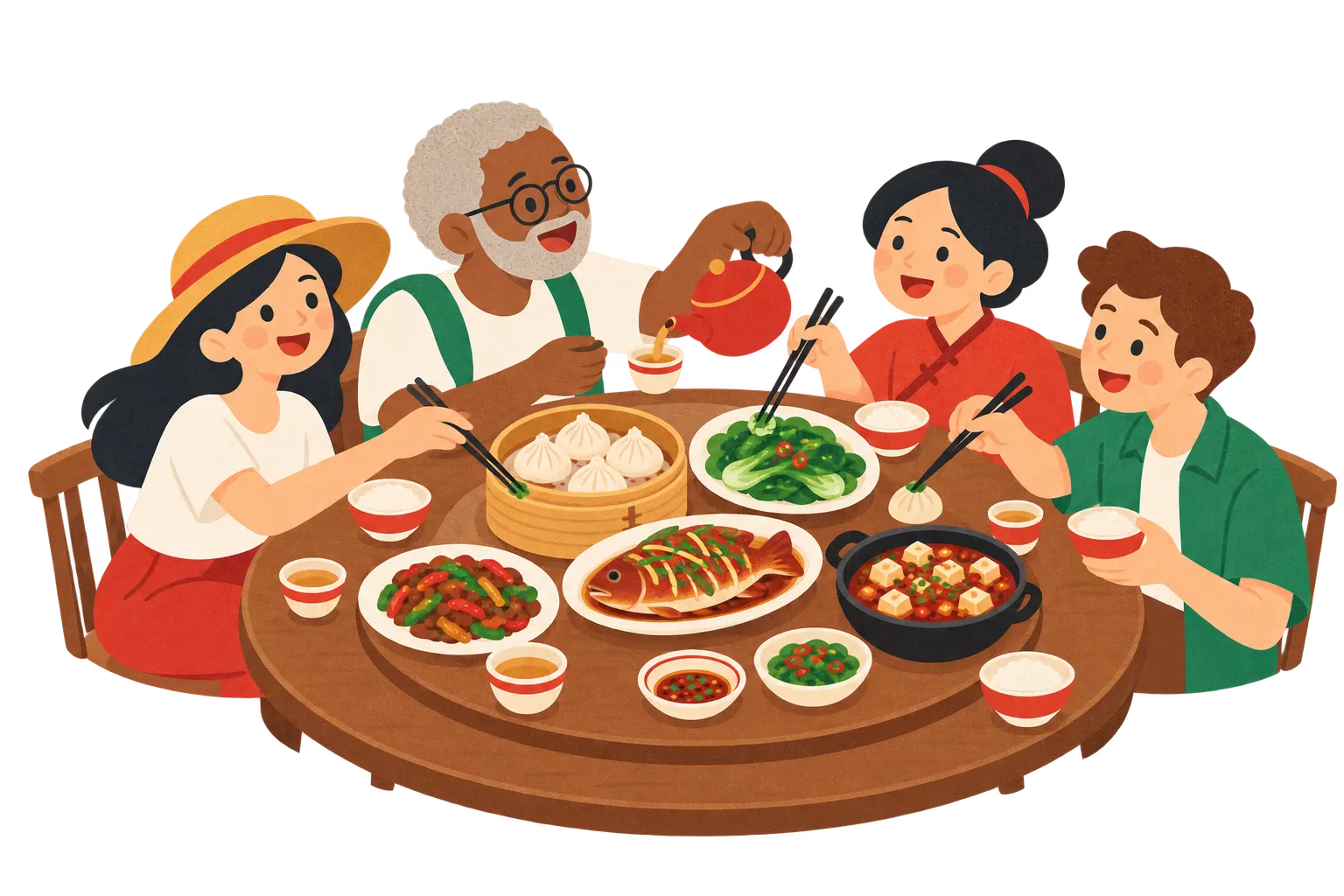
Most meals are shared: dishes go in the middle, often on a turntable, and everyone helps themselves. Many restaurants provide serving chopsticks (公筷, gōngkuài) and serving spoons (公勺, gōngsháo), something public health campaigns have promoted since 2020 (Sixth Tone); use them to take food from shared plates, and ask for a pair if there are none. Turn the turntable gently and check nobody is mid-serve.
- Don’t stand chopsticks upright in rice. It looks like incense at a funeral. Rest them on the holder or across your bowl.
- Don’t point with chopsticks, wave them around or stab food with them.
- Let the host or older guests start, and try a bit of everything you’re offered.
- Finishing is fine. Leaving a little food used to signal that the host was generous, but campaigns against food waste now encourage people to finish what they order.
- Thank whoever refills your glass or cup. At a casual meal, a nod or 谢谢 is enough.
These points follow a China Daily table etiquette guide republished by the Shanghai government. The tableware lesson has the words for chopsticks, spoons and bowls.
Asking for tableware
-
请给我们公筷。
Qǐng gěi wǒmen gōngkuài.
Please give us serving chopsticks.
-
请给我们公勺。
Qǐng gěi wǒmen gōngsháo.
Please give us a serving spoon.
-
请给我们两双筷子。
Qǐng gěi wǒmen liǎng shuāng kuàizi.
Please give us two pairs of chopsticks.
-
请给我们两个勺子。
Qǐng gěi wǒmen liǎng ge sháozi.
Please give us two spoons.
-
请给我们几个小碗。
Qǐng gěi wǒmen jǐ ge xiǎo wǎn.
Please give us a few small bowls.
-
请给我们一些纸巾。
Qǐng gěi wǒmen yìxiē zhǐjīn.
Please give us some napkins.
How does toasting work at a Chinese dinner?
At banquets and business dinners, the host usually makes the first toast, and toasts continue through the meal. 干杯 (gānbēi) literally means “dry the glass.” When you toast someone senior, stand if they are standing, hold your glass with both hands and keep its rim a little lower than theirs. You don’t have to drink alcohol: toasting with tea or a soft drink is normal, and 我不喝酒 (wǒ bù hē jiǔ, “I don’t drink alcohol”) said with a smile is accepted.
Who pays the bill in China?
Whoever invited usually pays for everyone, and friends often argue over the bill as a friendly ritual. If you’re a guest, offer once, accept graciously when your host insists, and offer to treat them next time; 我请客 (wǒ qǐngkè) means “It’s on me.” Among friends and younger people, splitting the bill is common and is often called “AA” (AA制, AA zhì). The bill lesson covers splitting and paying separately; payment itself is covered in the ordering food guide.
Paying and splitting
-
服务员,您好,我们想结账。
Fúwùyuán, nín hǎo, wǒmen xiǎng jiézhàng.
Excuse me, we would like to pay the bill.
-
这里面包含服务费吗?
Zhèlǐmiàn bāohán fúwùfèi ma?
Does this include the service charge?
-
可以分开付款吗?
Kěyǐ fēnkāi fùkuǎn ma?
Can we pay separately?
-
我们想各付各的。
Wǒmen xiǎng gè fù gè de.
We would like to each pay for our own items.
-
我们想平均分摊。
Wǒmen xiǎng píngjūn fēntān.
We would like to split it evenly.
⚠︎ Invitations from strangers
In tourist areas, be careful when friendly strangers suggest tea, a drink or a massage. The UK government warns that these “tea tasting” invitations can end with a very large bill and pressure to pay (FCDO). Choose the place yourself and check prices first.
How do you greet people in China?
A simple 你好 (nǐ hǎo) works everywhere; 您好 (nín hǎo) is the polite form for older people and in shops and hotels. In business and formal settings a handshake is normal, usually lighter than in many Western countries, often with a slight nod. Hugs and cheek kisses aren’t usual with people you’ve just met. Address people by family name and title, such as 王先生 (Wáng xiānsheng, Mr. Wang) or 李女士 (Lǐ nǚshì, Ms. Li), until they suggest otherwise, and give and receive business cards with both hands (Cultural Atlas).
You may be asked questions that feel personal, such as where you’re from, your age or whether you’re married. It’s usually friendly curiosity, and a smile and a light answer are fine. The greetings lesson covers the basics with audio.
Polite basics
-
你好。
Nǐ hǎo.
Hello.
-
您好。
Nín hǎo.
Hello (polite).
-
谢谢。
Xièxie.
Thank you.
-
不客气。
Bú kèqi.
You're welcome.
-
对不起。
Duìbuqǐ.
I'm sorry.
-
不好意思。
Bù hǎoyìsi.
Excuse me.
-
请问……
Qǐngwèn…
Excuse me, may I ask…
-
再见。
Zàijiàn.
Goodbye.
Do people queue in China?
Yes. Ticket halls, attractions and train stations use barriers and staff to manage lines, and metro platforms have marked waiting areas. Let passengers off before you board; many platforms display 先下后上 (xiān xià hòu shàng, “exit first, then board”). Expect bag security checks at metro and train stations. At busy spots people may stand closer than you’re used to and someone may try to slip ahead: hold your place calmly and say 不好意思,我在排队 (bù hǎoyìsi, wǒ zài páiduì, “Excuse me, I’m in line”). The metro guide covers stations in detail, and the queues and security lesson has the phrases.
Can you smoke in public in China?
Rules are set city by city, and the big cities are strict on paper. Beijing has banned smoking in indoor public places and workplaces since June 1, 2015, with fines of up to 200 yuan for individuals (National Health Commission). Shanghai bans smoking in all indoor public places, extended the ban to e-cigarettes in 2022, and banned vaping in metro stations and trains from March 2025 (Shanghai government). Smoking on high-speed trains, toilets included, can bring a fine of up to 2,000 yuan under a State Council railway rule in force since January 2014 (China Daily); don’t vape there either.
Enforcement varies, and you may still see people smoking in some restaurants, private dining rooms and smaller towns. Look for 禁止吸烟 (jìnzhǐ xīyān, no smoking) signs and use designated smoking areas. If smoke bothers you, ask for a non-smoking area (禁烟区, jìnyān qū) when you get a table.
Is it OK to take photos of people in China?
Ask first. A gesture at your camera usually does it, or say 可以给您拍张照片吗 (kěyǐ gěi nín pāi zhāng zhàopiàn ma, “May I take your photo?”). Ask parents before photographing children, and respect a no from vendors, monks or anyone else. You may also be asked to pose for photos yourself; saying no politely is fine.
Follow 禁止拍照 (jìnzhǐ pāizhào, no photography) signs, which are common inside temple halls and in some museum galleries; flash is often banned where photos are allowed. Don’t photograph military sites, police operations, or airport security and immigration areas. The UK government notes that restricted military areas aren’t always clearly signed (FCDO).
Asking about photos
-
这里可以拍照吗?
Zhèlǐ kěyǐ pāizhào ma?
Can I take photos here?
-
这里可以录像吗?
Zhèlǐ kěyǐ lùxiàng ma?
Can I record video here?
-
可以开闪光灯吗?
Kěyǐ kāi shǎnguāngdēng ma?
Can I use flash?
-
这里禁止拍照吗?
Zhèlǐ jìnzhǐ pāizhào ma?
Is photography prohibited here?
-
可以帮我拍张照片吗?
Kěyǐ bāng wǒ pāi zhāng zhàopiàn ma?
Could you take a photo for me?
How should you behave in a Chinese temple?
Active Buddhist and Taoist temples are places of worship as well as sights. Dress modestly, keep your voice down, and don’t touch or climb on statues or altars. Step over the raised threshold at a hall’s doorway rather than standing on it. Follow posted rules on photography and incense: some temples hand out free incense and ask visitors not to bring their own. You never have to burn incense or pay for a blessing; if anyone pressures you to buy expensive incense, decline and walk on.
What gift should you bring to a Chinese host?
If you’re invited to someone’s home or meeting business contacts, a small gift from your home country, such as snacks, tea or a local specialty, is a good choice. Offer it with both hands. Your host may decline once or twice out of politeness before accepting, and many people don’t open gifts in front of the giver (Cultural Atlas). Many households take shoes off indoors, so follow your host’s lead.
- Avoid clocks. “Giving a clock” (送钟, sòng zhōng) sounds like attending someone’s death (送终).
- Avoid sets of four. 四 (sì, four) sounds like 死 (sǐ, death).
- Skip knives, scissors and umbrellas, which can suggest cutting ties or separation.
- Red and gold wrapping reads as festive; plain white or black is better avoided.
Frequently asked questions
Is it rude to refuse food or drink in China?
Not if you’re polite about it. Hosts often offer more than once out of hospitality, so a smile and 我吃饱了,谢谢 (wǒ chībǎo le, xièxie, “I’m full, thank you”) is fine.
Should I leave a tip at a hotel in China?
It isn’t expected. Check your bill for a service charge; at international hotels a small tip for a porter or housekeeping is accepted but optional.
Do I need to dress conservatively in China?
Not in everyday city life, where dress is much like in other big cities. Dress modestly for temples and other religious sites, and follow any posted rules.
Is it rude to call out to a waiter in China?
No. In busy restaurants, raising your hand and saying 服务员 (fúwùyuán) is the normal way to get attention, and staff rarely come by unasked.
Practice the Mandarin for this
- 1 Hello, thank you and other lifesavers in ChineseBasics · 15 phrases with audio
- 40 Extra orders, service and tablewareFood · 23 phrases with audio
- 41 The bill, leftovers and invoiceFood · 23 phrases with audio
- 52 Photos, guided tours and visitor servicesSightseeing · 23 phrases with audio
- 51 Queueing, security and entrySightseeing · 23 phrases with audio
- 37 Getting a table in ChineseFood · 23 phrases with audio
Sources
Facts checked October 31, 2026. Rules change; check the official source before you travel.
- Shanghai Municipal Administration of Culture and Tourism: Is tipping necessary when dining in Shanghai?
- Visit Beijing (Beijing Municipal Bureau of Culture and Tourism): tipping in Beijing (2016)
- National Health Commission: Beijing smoking ban takes effect (June 2015)
- Shanghai government: Shanghai implements e-cigarette ban on metro trains, stations (February 2025)
- Shanghai government (China Daily): Guide to table etiquette in China (September 2024)
- UK FCDO: China travel advice, safety and security
- China Daily: Fines for smoking on high-speed trains (December 2013)
- Sixth Tone: Change your chopstick habits to curb COVID-19, cities say (2020)
- The Cultural Atlas: Chinese culture, etiquette
- The Cultural Atlas: Chinese culture, greetings